
Best Amazon Repricer 2026: 5 Tools Compared for UK Sellers
There is no universally “best” Amazon repricer. The right choice depends on your catalogue, marketplaces, fulfilment model, appetite for automation and the amount of control you need over margin.
This 2026 shortlist is written for UK sellers who want to compete for the Featured Offer without turning every listing into a race to the bottom. It compares the questions that matter in practice: floor-price protection, strategy control, setup effort, support fit and how easily you can verify what the repricer is doing.
Disclosure: Ascent is our product. We have kept the evaluation criteria explicit so you can challenge the conclusion, and we recommend checking every provider’s current pricing, marketplace coverage and trial terms before buying.
Best Amazon repricers at a glance
| Tool | Best fit | What to validate |
|---|---|---|
| Ascent | UK-first sellers who want profit guardrails and guided workflows | How the workflow handles your real costs, VAT and ageing stock |
| Seller Snap | Larger multi-marketplace teams wanting an advanced strategy layer | Plan limits, onboarding depth and the controls your team will actually use |
| BQool | Sellers who want a broad range of rule and automation options | Which plan matches your listing count and required strategy features |
| RepricerExpress | UK sellers who prefer a familiar rule-led approach | Rule maintenance, update behaviour and migration effort |
| Informed.co | Teams comparing Amazon repricing with broader channel needs | Current marketplace coverage, integrations and UK support fit |
How to judge an Amazon repricer
Feature lists are easy to inflate. A useful evaluation starts with the decisions the software will make with your money.
1. Margin protection
Ask how the repricer calculates and enforces a safe floor. Your product cost is only the start: referral fees, fulfilment fees, VAT, prep costs, shipping and your required return all matter. A minimum price field is not enough if the workflow makes it easy to leave costs incomplete.
2. Strategy clarity
You should be able to explain why a price changed. Look for readable rules, decision history, guardrails and a clear way to pause or override automation. “AI” is not a substitute for accountable behaviour.
3. Buy Box behaviour without blind undercutting
The cheapest offer does not automatically win. Fulfilment, delivery promise, stock, seller performance and offer eligibility matter too. A good repricer should know when to compete, when to hold and when to raise a price rather than undercut every visible offer.
4. UK operating fit
For Amazon UK, check GBP billing, VAT treatment, UK support hours and whether the onboarding language matches how UK sellers calculate landed cost. Global marketplace coverage is useful only if you genuinely need it.
5. Safe onboarding
A strong trial starts with a controlled SKU group, verified floors and a before/after benchmark. Avoid switching an entire catalogue on day one. You want evidence from your own account, not a vendor’s average.
The five-tool shortlist
Ascent: best for UK-first, margin-led workflows
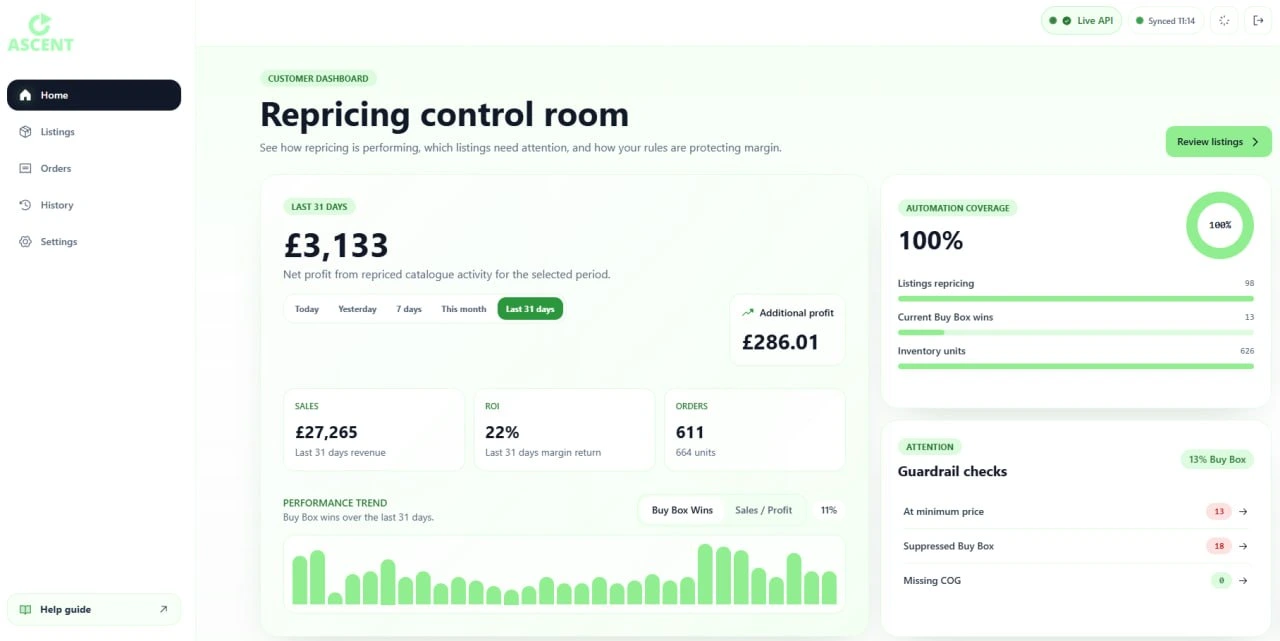
Ascent is designed around UK Amazon sellers who want pricing automation with visible profit and ROI guardrails. It is a strong fit when you want a guided workflow rather than a large toolbox that still needs extensive rule design.
Shortlist Ascent if: UK support matters, you want VAT-aware economics, and your priority is protecting contribution while remaining competitive. Use the trial to verify floors, price history and workload reduction on a small SKU cohort.
Explore Ascent’s repricing controls or start a controlled trial.
Seller Snap: best for advanced multi-marketplace teams
Seller Snap is commonly considered by larger sellers who want an advanced strategy system and broader marketplace operation. The trade-off is that sophisticated tooling can require more onboarding, governance and plan scrutiny.
Shortlist Seller Snap if: your team operates across several marketplaces and has the time and expertise to manage a more advanced repricing programme. Check current plan limits and support arrangements directly.
Compare Seller Snap with Ascent.
BQool: best for a broad rule-and-automation toolkit
BQool is an established option with multiple repricing approaches and plan choices. It suits sellers who want to configure detailed behaviour and are comfortable matching plan limits to catalogue size and required features.
Shortlist BQool if: you value a broad toolkit and are willing to spend time selecting and maintaining the right configuration.
RepricerExpress: best for a familiar rule-led UK option
RepricerExpress is a familiar name for UK sellers who prefer conventional rule-based repricing. It can be a sensible choice when predictable rules matter more than newer workflow or strategy layers.
Shortlist RepricerExpress if: you want a UK-oriented rule system and your team already knows how it wants to configure competitor and floor-price logic.
Compare RepricerExpress with Ascent.
Informed.co: best when channel breadth matters
Informed.co is worth reviewing when your repricing decision sits inside a broader multi-channel operation. Marketplace and integration coverage can change, so validate your exact channels and support needs directly.
Shortlist Informed.co if: Amazon is one part of a wider commerce stack and cross-channel fit matters more than UK-specific onboarding.
Compare Informed.co with Ascent.
Which repricer should you choose?
- UK-first and margin-led: start with Ascent.
- Advanced multi-marketplace operation: compare Seller Snap.
- Broad configurable toolkit: review BQool.
- Familiar UK rule-based workflow: consider RepricerExpress.
- Broader channel requirements: assess Informed.co against your stack.
The deciding test is not the demo. Export a representative SKU sample, document the current Buy Box share and margin, set verified floors, and run one repricer at a time. Compare outcomes after a meaningful test window.
Questions to ask before signing up
- Can I explain every price change from the history?
- What happens when cost data or marketplace data is missing?
- Can I pause the account or a SKU group immediately?
- How are VAT, fees and fulfilment costs represented?
- Which features and listing limits apply to the plan I would actually buy?
- What support is available during my operating hours?
- How do I export my settings if I leave?
Final recommendation
For a UK seller who wants clear margin controls, a guided setup and support aligned with UK hours, Ascent belongs at the top of the shortlist. Sellers with larger global operations should compare it directly with Seller Snap; sellers who prefer a configurable rule toolkit should also test BQool and RepricerExpress.
Use the full Amazon repricer comparison framework before you choose, or test Ascent with a controlled SKU group.
Still deciding which products deserve automation? Start with the free Amazon sales estimator and BSR calculator, then validate demand, fees and margin before buying stock.